CC 3891 / 5891 Foundations of Computational Biology
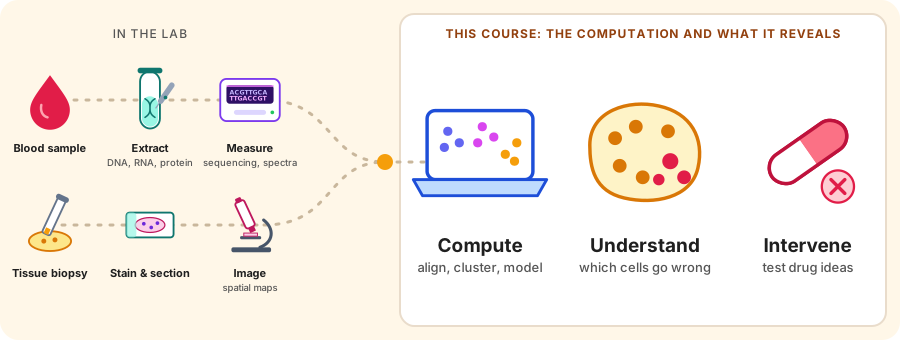
From DNA to cells to disease: understanding biology through computation.
Big questions in biology
Modern experiments turn these questions into data: the letters of a genome, the activity of thousands of genes in each of millions of cells, the positions of those cells inside a tissue. Nobody can read that by eye. Algorithms, mathematics and machine learning let us find the pattern, ask whether it is real, and connect it back to the biology.
This course introduces those computational ideas and lets you use them on real biological datasets.
Explore biology through code
Four themes, each starting from a biological question and building a computational idea to answer it. You will work with a few widely used Python tools along the way; the tools are there to help you explore the ideas, not as separate subjects to master.
Explore genomes
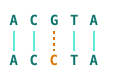
How similar are two stretches of DNA, and how do we piece a genome together from short reads?
- Concepts
- DNA sequences, alignment, genome assembly, dynamic programming
- Tools
- Biopython, BLAST, and a sampling of aligners and assemblers (e.g. minimap2, BWA, MAFFT, SPAdes)
Explore genomes
How similar are two stretches of DNA, and how do we piece a genome together from short reads?
- Concepts
- DNA sequences, alignment, genome assembly, dynamic programming
- Tools
- Biopython, BLAST, and a sampling of aligners and assemblers (e.g. minimap2, BWA, MAFFT, SPAdes)
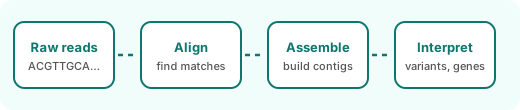
Schematic illustration, not real data.
Sequencers give us millions of short, noisy reads. We align them against each other or a reference to find where they match, assemble overlapping reads into longer stretches, and then ask what the differences mean. Dynamic programming is the idea that makes careful alignment efficient.
Go deeper: Biopython tutorial · NCBI BLAST
Discover cell types
Which cells in a sample are alike, and how many kinds are there?
- Concepts
- Gene expression, PCA, clustering, UMAP
- Tools
- Scanpy
Discover cell types
Which cells in a sample are alike, and how many kinds are there?
- Concepts
- Gene expression, PCA, clustering, UMAP
- Tools
- Scanpy
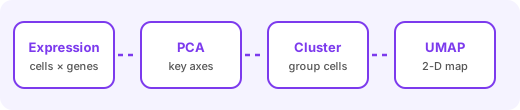
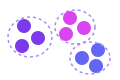
Schematic illustration, not real data.
Single-cell data is a table of how active each gene is in each cell. We compress it to a few informative axes with PCA, group similar cells by clustering, and draw the result as a 2-D UMAP map you can read against known biology.
Go deeper: Dimensionality reduction · Clustering
Map tissues
Does where a cell sits tell us something about what it does?
- Concepts
- Spatial organization, graphs, cellular neighborhoods
- Tools
- Squidpy
Map tissues
Does where a cell sits tell us something about what it does?
- Concepts
- Spatial organization, graphs, cellular neighborhoods
- Tools
- Squidpy
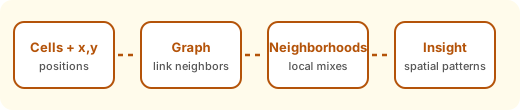
Schematic illustration, not real data.
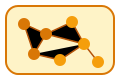
Spatial experiments keep each cell's position. We connect nearby cells into a graph, summarize who lives next to whom, and look for neighborhoods and patterns that only appear once location is taken into account.
Go deeper: Spatial omics intro · Neighborhood analysis
Build predictive models
Can a model learn to tell healthy from diseased from the data alone?
- Concepts
- Classification, representation learning
- Tools
- scikit-learn, introductory PyTorch
Build predictive models
Can a model learn to tell healthy from diseased from the data alone?
- Concepts
- Classification, representation learning
- Tools
- scikit-learn, introductory PyTorch
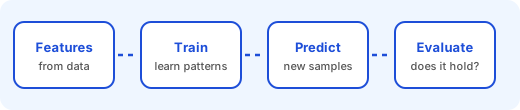
Schematic illustration, not real data.
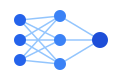
We turn samples into numbers, train a classifier on labeled examples, and test it on data it has not seen. Representation learning asks whether a model can discover useful features by itself, and we practice checking whether a result can be trusted.
Go deeper: scikit-learn · PyTorch basics
What you will learn
By the end of the course you should be able to:
- Translate a biological question into a computational problem.
- Analyze and visualize real biological datasets using Python.
- Understand foundational algorithms and machine-learning concepts.
- Investigate genes, cells and the organization of tissues.
- Interpret computational results in their biological context.
Who should take this course?
Anyone curious about where computing meets biology, whether you come from computer science, biology, biomedical engineering, mathematics or data science. Undergraduates (CC 3891) and graduate students (CC 5891) are both welcome and learn together.
- Prerequisites: TODO: to be confirmed
- Expectations for CC 3891 (undergraduate): TODO: to be confirmed
- Expectations for CC 5891 (graduate): TODO: to be confirmed
- Grading, schedule and assignments: TODO: to be announced
- Meeting time and location: TODO: to be announced
Registration
Find the course by searching for CC 3891 or CC 5891 in the Spring 2027 term on Vanderbilt YES. Section and class number: TODO: add once listed. Questions? Contact the instructor, Hirak Sarkar.